

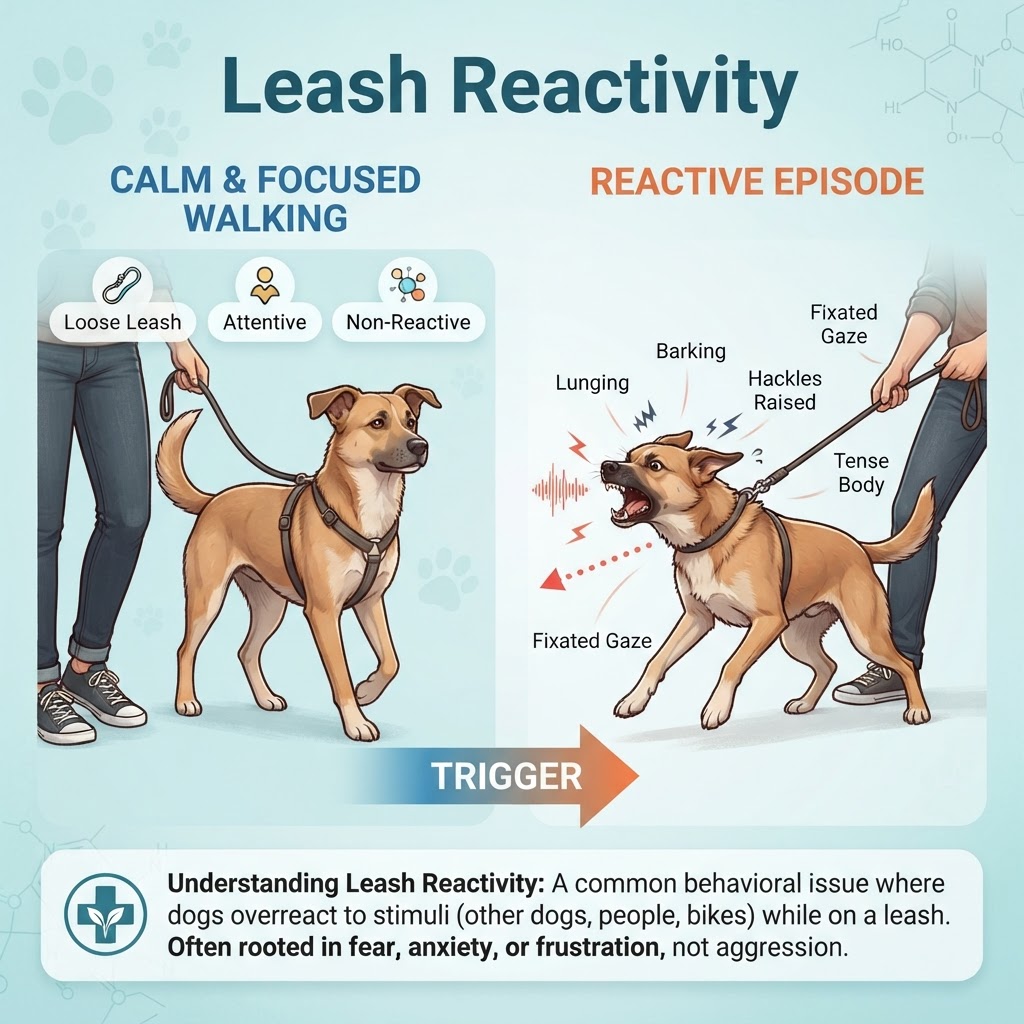
Understanding Leash Reactivity and Barrier Frustration
Leash reactivity is a complex behavioral phenomenon where a canine displays excessive arousal or defensive behaviors—such as barking, lunging, or snarling—while tethered. This is not necessarily an inherent form of Aggression, but rather a failure of the dog to cope with a perceived threat or high-excitement stimulus while their freedom of movement is restricted. Unlike general Compulsive Disorder, leash reactivity is highly context-dependent and usually specific to the act of being restrained.
The Neurobiology of the Reactive Response
When a dog encounters a trigger, the amygdala initiates an immediate stress response. In a reactive dog, this 'amygdala hijack' occurs rapidly, bypassing the more rational centers of the brain. The leash itself acts as an artificial barrier that prevents the natural canine instinct to circle or gain distance, causing the dog to feel trapped. This state often mirrors Noise Phobia in terms of the internal state of panic the dog experiences.
Diagnostic Indicators and Behavioral Markers
Identifying the underlying motivation is key to effective management. Veterinarians differentiate between fear-based reactivity and barrier frustration based on body language cues during the encounter.
Clinical Signs of Fear-Based Reactivity
-
Tucked tail and lowered body posture.
-
Avoidance of eye contact with the stimulus.
-
Panting, lip licking, or yawning as displacement behaviors.
Indicators of Barrier Frustration
-
High-pitched, frantic barking or whining.
-
Bouncing or jumping towards the trigger.
-
Inability to focus on the handler despite high-value rewards.
Management Strategies and Behavioral Modification
Effective intervention must focus on lowering the dog's physiological arousal levels. A systematic approach often involves a combination of environmental control and positive reinforcement protocols.
Desensitization and Counter-Conditioning (DSCC)
DSCC involves exposing the dog to the trigger at a distance where they remain below their 'threshold'—the point at which they lose the ability to focus on the handler. By pairing the presence of the stimulus with a high-value reinforcer, the dog's emotional response is gradually altered from 'fear/frustration' to 'positive anticipation.' This is distinct from the management of Canine Compulsive Disorder because it is inherently grounded in social environmental interaction.
Environmental Management and Routine Alterations
Until the behavior improves, owners should utilize 'management tools' to prevent the rehearsal of the reactive behavior. This may include changing walking times to avoid high-traffic areas, utilizing body-harnesses that allow for better control, and creating 'escape' routes during walks. Ignoring the issue often leads to escalating anxiety, similar to how Separation Anxiety manifests when left untreated.
Professional Support and Prognosis
In cases where the reactivity is intense, veterinary behavioral modification may include psychopharmacological support to lower the baseline anxiety. While not a 'cure,' medication can provide the necessary 'calm window' for the training to be effective.
