

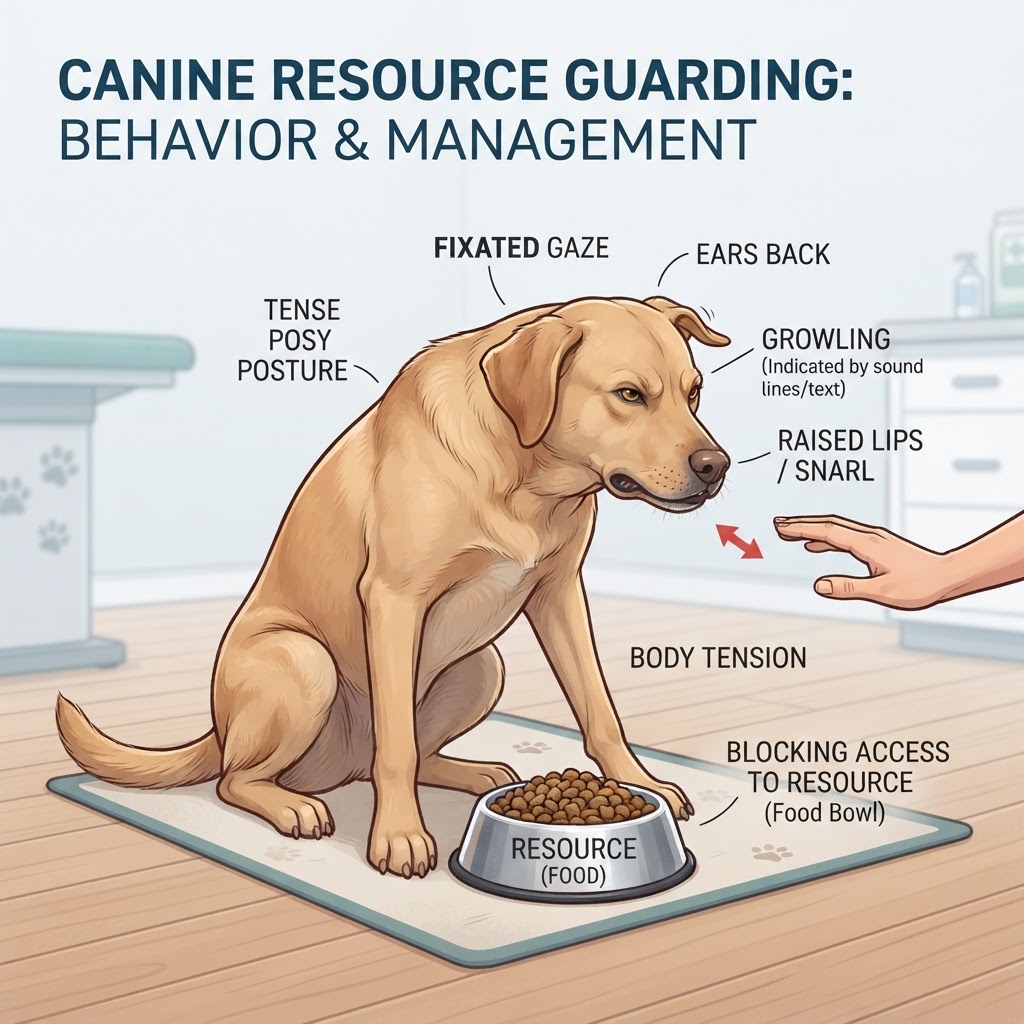
Understanding Resource Guarding in Canines
Resource guarding is the expression of defensive behaviors related to the possession of food, toys, bones, or resting locations. This behavior is rooted in the instinct to protect vital survival assets. In a domestic context, it is a frequent precursor to Aggression, requiring careful management to ensure household safety.
Spectrum of Defensive Behavior
-
Food Guarding: Reactivity surrounding bowls or treats.
-
Positional Guarding: Defense of resting areas like sofas or crates.
-
Object Guarding: Reactivity toward stolen or 'high-value' items such as socks or household objects.
Identifying Early Warning Signals
Recognition of the subtle warning signs is critical to preventing escalation. Often, owners miss early cues, leading to a 'sudden' bite. Always look for these signs of discomfort when approaching a resting or eating dog.
Micro-Expressions of Discomfort
-
Freezing: The dog abruptly stops moving or chewing when approached.
-
Whale Eye: The sclera (white of the eye) becomes visible, indicating high stress.
-
Lip Licking: A non-social signal of internal tension.
-
Lowered Head: A shift in posture to cover the item.
Advanced Defensive Indicators
-
Stiffening: Rigid body posture or a lowered tail.
-
Growling: A vocalization that serves as a final warning.
-
Snapping: An unsuccessful attempt at contact.
Etiology: The Path to Defensive Reactivity
Resource guarding is not a single diagnosis but a complex behavioral outcome. It may stem from a Socialization Deficit early in life, where the dog did not learn to trade items safely. Additionally, dogs experiencing Compulsive Disorder may show higher baseline levels of anxiety, making them more susceptible to guarding. Genetics also play a role, as certain breeds have higher propensities for possessiveness.
Diagnostic Approach in Veterinary Practice
Diagnosing resource guarding is primarily clinical, based on owner reports and behavioral observations. Because guarding can be exacerbated by pain, a comprehensive physical examination is required to rule out underlying orthopedic or dental issues that may make the dog feel vulnerable.
Behavioral Assessment Protocols
- History Taking: Detailed inquiry into the trigger, the environment, and the victim of the behavior.
- Pain Assessment: Evaluation for chronic pain that might lower the threshold for defensive reactions.
- Differential Exclusion: Ruling out Separation Anxiety or Noise Phobia which may look similar in context.
Therapeutic Intervention Strategies
Treatment focuses on systematic desensitization and counter-conditioning. Never punish a dog for growling, as this suppresses the warning sign, increasing the risk of unannounced biting.
Behavioral Modification Techniques
-
Trading Up: Teaching the dog that relinquishing a low-value item results in a higher-value reward.
-
Safety Management: Removing the stimulus, such as using baby gates or keeping the dog in a separate area during high-value treat sessions.
-
Environmental Stability: Reducing overall stress to prevent the buildup of anxiety, which often triggers reactivity similar to Leash Reactivity.